
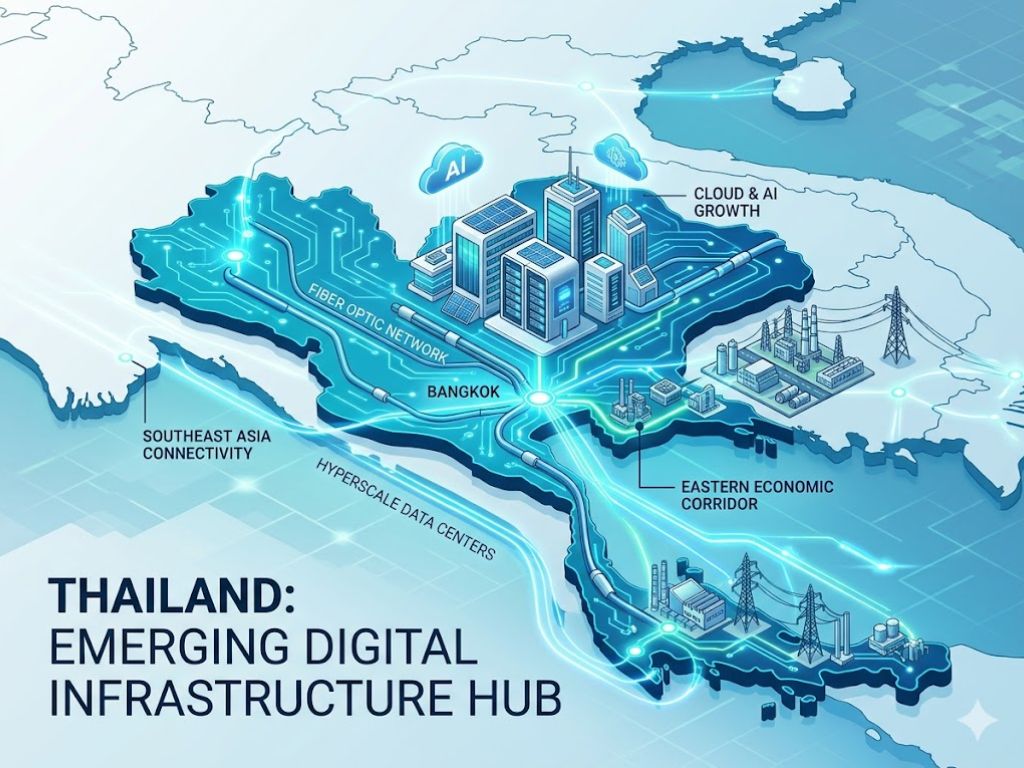
Rising AI demand, hyperscale expansion, and regional data flows are accelerating Thailand’s transition from a secondary market into a serious contender in Southeast Asia’s digital infrastructure landscape.
Thailand’s data center sector is no longer niche. It is moving into the same conversation as logistics, industrial estates, and energy assets—where long-term demand is driven less by cycles and more by structural shifts in the digital economy.
Market momentum is real—but still early-stage
The headline numbers suggest strong expansion:
- Market size: USD 1.45–1.85 billion in 2025
- Projected size: USD 4.3–6.3 billion by 2030
- Growth rate: 18–27% CAGR
- Capacity: scaling from ~350 MW toward 1 GW by 2027
However, these figures need context. Even at 1 GW, Thailand will still sit below more mature hubs like Singapore and emerging hyperscale clusters like Johor in Malaysia.
What this indicates is not saturation—but headroom. Thailand is still in a build-out phase where infrastructure is catching up with demand rather than competing in an oversupplied market.
The key demand drivers are structural:
- Enterprise and hyperscale cloud adoption across ASEAN
- AI workloads requiring higher rack density and power intensity
- 5G and IoT expansion increasing data generation
- Regulatory shifts toward data localization
This is less about cyclical growth—and more about long-term digital dependency.
Capital deployment signals long-term conviction
Global operators are already committing significant capital:
- AWS: > USD 5 billion
- Google: ~USD 1 billion
- Microsoft: expanding AI and cloud footprint
- ByteDance (TikTok): multi-billion-dollar rollout
- Regional and global operators: ST Telemedia, GDS, Equinix, NTT
Recent approved projects exceed USD 3 billion and 376 MW in capacity.
This level of early-stage capital deployment suggests that Thailand is not being treated as a speculative market—but as part of long-term regional infrastructure strategy.
Why Thailand is gaining traction
Data center investment ultimately depends on three fundamentals: power, connectivity, and regulatory clarity. Thailand is not perfect—but it is increasingly competitive across all three.
Connectivity is sufficient—and improving
Thailand is connected to over a dozen submarine cable systems and continues to expand its role in regional data routing. While it is not a primary landing hub like Singapore, it offers increasingly viable redundancy and intra-ASEAN latency performance.
Policy support is a differentiator
BOI incentives play a significant role in improving project viability:
- Up to 8 years corporate tax exemption
- Import duty exemptions on critical equipment
- 100% foreign ownership structures
- Land ownership rights under promoted investment schemes
- Streamlined permitting processes
For foreign investors, this reduces both entry friction and long-term operational cost.
Geographic positioning supports regional strategy
Thailand sits between key ASEAN markets, making it relevant not just for domestic demand, but for regional traffic distribution and backup infrastructure.
Location strategy: Bangkok vs EEC is not interchangeable
One of the more overlooked dynamics is that Thailand is not a single-market play. Location strategy directly affects investment outcomes.
Bangkok: demand-driven, space-constrained
Bangkok remains the core for:
- Enterprise colocation
- Financial institutions
- Government and regulated workloads
Its advantages include dense fiber networks, workforce availability, and existing infrastructure. However, land constraints and power limitations may cap large-scale hyperscale expansion.
Eastern Economic Corridor (EEC): supply-driven growth
Chonburi and Rayong are emerging as the next phase of development.
They offer:
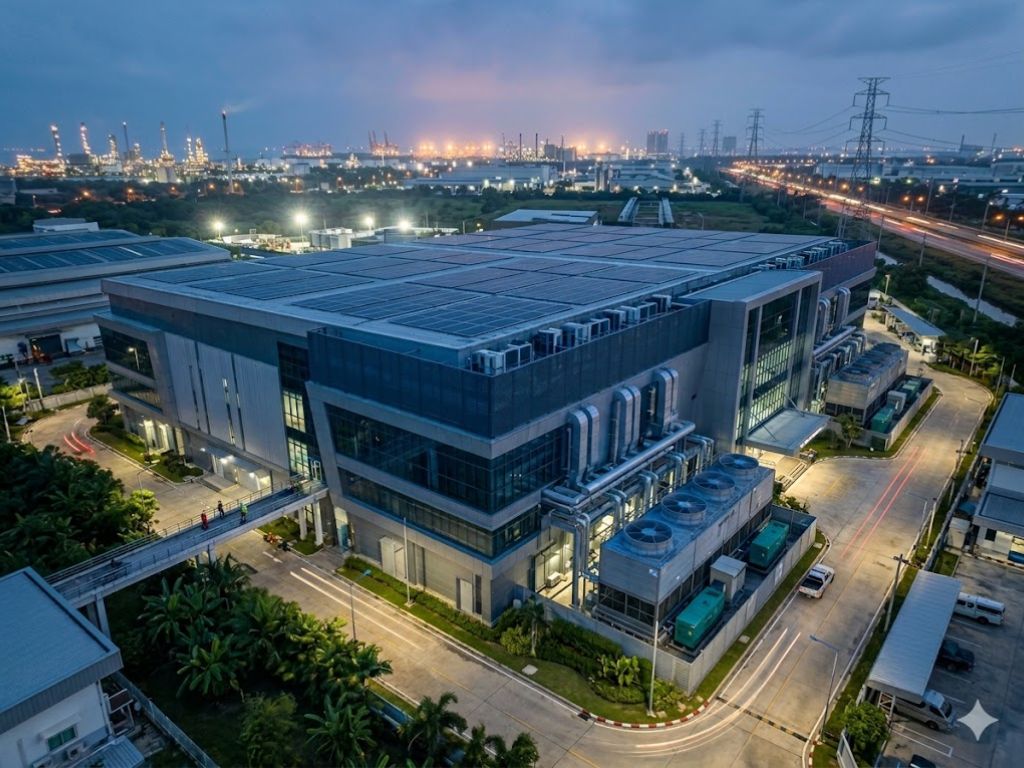
- Larger land plots suitable for campus-scale development
- Proximity to industrial-grade power infrastructure
- Faster approvals and more flexible zoning
- Access to submarine cable landing proximity
This is where hyperscale players are increasingly positioning for long-term expansion rather than immediate demand capture.
Entry costs reflect infrastructure intensity
Data centers are not traditional real estate assets. They are capital-intensive infrastructure plays.
Typical investment ranges:
- Edge facilities: USD 5–30 million
- Colocation: USD 20–80 million
- Hyperscale: USD 100–250 million+
More importantly, cost is heavily influenced by power provisioning, redundancy requirements, and connectivity—not just land.
Investors typically choose between:
- Acquiring operational assets for faster yield
- Developing new sites for control and scalability
Each comes with trade-offs between speed, risk, and long-term value creation.
Risks are real—and often underestimated
While the growth narrative is compelling, several constraints deserve closer attention:
- Power availability vs scalability: Securing initial capacity is one thing; scaling to hyperscale levels is another
- Electricity pricing competitiveness: Thailand must remain competitive with Malaysia and Indonesia
- Grid reliability and redundancy: Critical for hyperscale uptime requirements
- Land and zoning complexity: Especially near urban centers
- Environmental exposure: Flood risk remains location-specific and requires careful mitigation
These are not deal-breakers—but they are execution risks that differentiate experienced investors from opportunistic entrants.
What this means for investors and developers
Thailand’s data center sector sits in an interesting position:
not yet saturated, but no longer undiscovered.
It offers:
- Infrastructure-grade investment opportunities
- Long-term leases with global tenants
- Exposure to structural digital growth
But success depends less on timing the market—and more on understanding power access, location strategy, and partnership structures.
Final perspective
Thailand is unlikely to replace Singapore as a primary hub.
But it doesn’t need to.
Its role is increasingly that of a complementary node—supporting overflow capacity, regional distribution, and long-term expansion in a rapidly growing ASEAN digital economy.
For investors, that may be where the real opportunity lies: not in competing with established hubs, but in positioning ahead of the next wave of infrastructure demand.
FAQ: Thailand Data Center Investment
1) Is Thailand a good market for data center investment?
Yes. Demand from cloud, AI, and enterprise users is growing fast. Government incentives and strong connectivity support long-term expansion. Global hyperscalers are already investing billions, which signals confidence in the market.
2) What are the best locations for data center development?
Bangkok suits colocation and enterprise clients due to connectivity and workforce. The Eastern Economic Corridor, especially Chonburi and Rayong, fits hyperscale projects with large land plots, power access, and faster approvals.
3) How much investment is required to enter the market?
It depends on your scale. Smaller edge facilities start around USD 5 million. Colocation projects range from USD 20 to 80 million. Hyperscale developments typically exceed USD 100 million.
4) Can foreign investors own data center projects in Thailand?
Yes. With BOI promotion, foreign investors can hold 100 percent ownership, access tax incentives, and obtain land rights for approved projects. This makes Thailand accessible compared to many regional markets.
5) What are the main risks investors should consider?
Power supply, energy costs, and talent shortages are key concerns. Regulatory compliance and flood risk also matter. Careful site selection and working with local partners can reduce these risks significantly.